
Welcome to Yorkshire
Published on February 18th, 2026
•The site of St Martin’s Church, Allerton Mauleverer has hosted a religious structure since the Norman era when a member of the Mauleverer family founded a priory nearby. Archaeological investigations in 1976 revealed medieval foundations and an apsidal chancel likely dating to the 12th century. Over subsequent centuries, the building saw additions — notably 14th- and 15th-century work — reflecting evolving liturgical and architectural fashions.
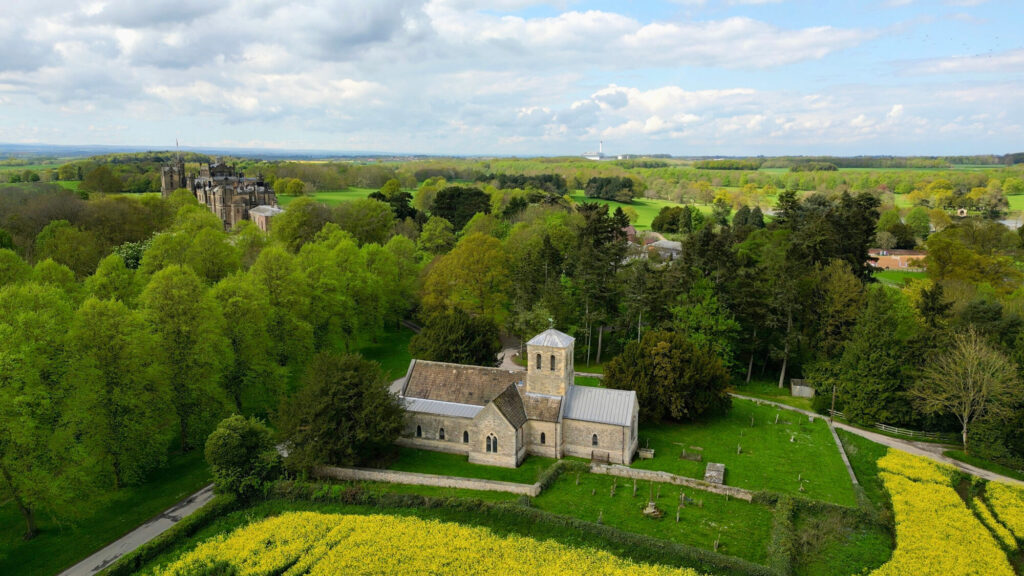
In c.1745-46 the medieval church was almost entirely remodelled for Richard Arundell, heir to the Mauleverers and Member of Parliament for Knaresborough. The reconstruction adopted a neo-Norman style.
St Martin’s is constructed of ashlar and coursed limestone and comprises a six-bay nave with north and south aisles, transepts, a two-bay chancel, and a central three-stage tower between nave and chancel. The central tower’s upper stage holds bell openings on each face, with a shallow pyramidal roof topped by a weathervane.
Inside, the church retains a range of fixtures from the 18th-century rebuild: a vase-shaped baptismal font, a two-deck pulpit with sounding board, and panelled box pews, typical of Georgian Anglican churches. The roof structure is a striking hammerbeam design, and a painting of Moses and Aaron adorns the chancel arch, lending a sense of continuity with older Christian iconography.
In the north transept are remarkable medieval memorials: two wooden effigies of cross-legged knights — likely 13th or early 14th century — and two alabaster effigies of 1475 commemorating Sir John Mauleverer and his wife. Also present is a brass of c.1400 for Sir John and Eleanor Mauleverer. The south transept houses the tomb of Mary Thornton, who died in 1800.
The church was declared redundant on 1 December 1971 and placed in the care of The Churches Conservation Trust in 1973. It is now preserved, not as an active parish church but as a heritage monument; its Grade II* listing underscores its architectural and historical significance.
Books by Dr Emma Wells #ad


Emma Wells
Dr Emma Wells has appeared as a historian on Yesterday, Curiosity Stream, Viral History, From the Dales to the Sea – A Great British Story, and as a ‘Don’ on BBC Radio 4’s The 3rd Degree and much more. Her first book, Pilgrim Routes of the British Isles, was released in 2016, and her most recent book Heaven On Earth: The Lives & Legacies of the World’s Greatest Cathedrals, was published in 2022.
View all articles →