Welcome to Yorkshire
Published on June 4th, 2026
•At the centre of the Lower Wensleydale village of East Witton stands St John’s Church. Yet the village’s older spiritual heart lies hidden nearby at Low Thorpe, where the abandoned churchyard of St Martin’s rests beneath tangled grass, nettles, and trees. Weathered gravestones lean at odd angles among the undergrowth, marking the resting places of generations of local families.
Worship is believed to have taken place at Low Thorpe for centuries, perhaps since the Norman era or earlier, when the church here was dedicated to St Ella. By the beginning of the 19th century, however, the medieval building had fallen into serious disrepair. Its crumbling condition coincided with dramatic changes in the village itself. After a devastating fire destroyed much, the settlement was rebuilt around 1809, largely around the current green. At the same time, the Earl of Ailesbury of the nearby Jervaulx Abbey estate commissioned a new church on a more prominent site closer to the reshaped village. Stone from the ancient church was dismantled and reused in the replacement building.
The new church, dedicated to St John the Evangelist, was designed by H. H. Seward in the unusually assured Gothick style, so praised architectural historian Nikolaus Pevsner. Constructed from local sandstone beneath a stone-slate roof, it embodied the Regency fascination with medieval architecture and romantic revivalism, featuring a battlemented west tower, and elegant Perpendicular-style windows. In the 1870s, architect George Fowler Jones carried out careful restoration work that preserved the building’s character while refining its interior and structure.
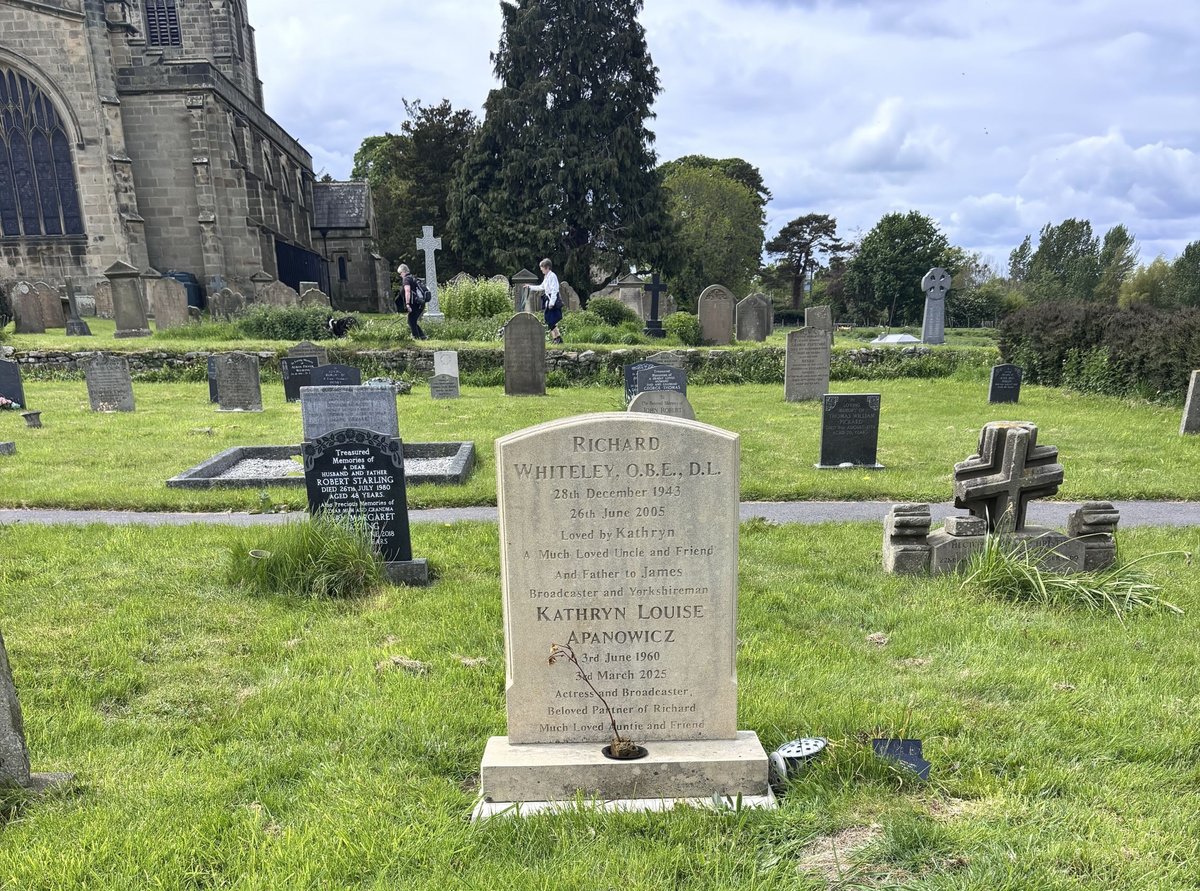
Inside, the church features decorative tiles in the chancel depicting the Lord’s Prayer, the Creed, and the Ten Commandments, while royal coats of arms honour both George III and Queen Victoria. Meanwhile, the cemetery continues to gather stories of its own. Among those buried is Richard Whiteley, the much-loved presenter of Countdown, whose grave links to a more recent chapter of Yorkshire history.
Books by Dr Emma Wells #ad