Welcome to Yorkshire
Published on July 15th, 2026
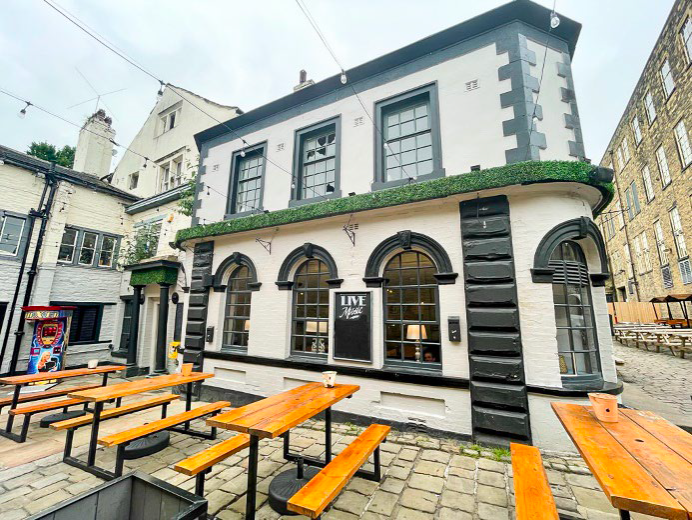
•Standing unassuming on Southgate in the heart of Halifax, the Old Cock is one of the town's oldest and, in fact, one of its most significant surviving buildings. Originally constructed around 1580 as a prestigious townhouse for the Savile family, the building was converted into an inn in 1668, reflecting Halifax's growing importance as a centre of trade and commerce.
Over the centuries, it has welcomed merchants, travellers and local societies, becoming woven into the social and economic life of the town. It was also associated with the infamous Cragg Vale coiners*, with the notorious "King" David Hartley arrested there in 1769. The Oak Room later became the meeting place where the foundations of what became the Halifax Permanent Benefit Building Society (Halifax Building Society) were laid.
A group of friends, including Branwell Brontë, regularly gathered here and at other local pubs. Branwell accumulated unpaid bills at the inn, and in 1848, the landlord, Mr Nicholson, wrote to the Reverend Patrick Brontë requesting that the outstanding debt be settled.
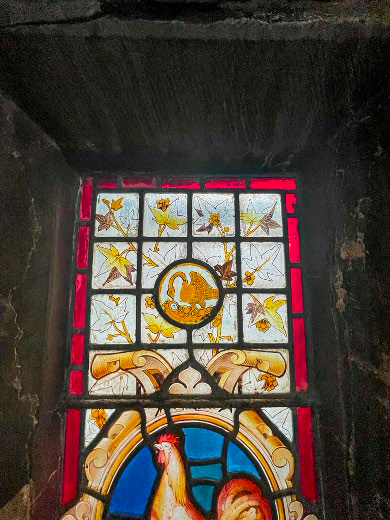
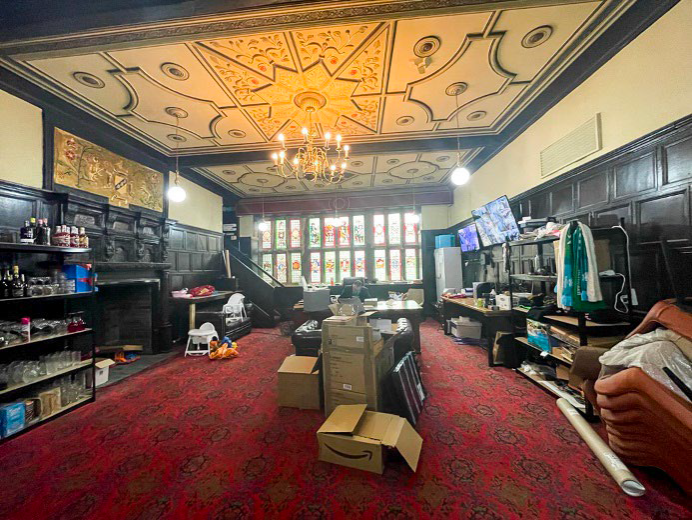
Today, the Old Cock is a Grade II listed building, recognised for both its architectural and historic significance. Although altered over the centuries, its core structure dates from the early 17th century and retains many original features. The celebrated Oak Room retains extensive oak panelling, a carved 16th -century fireplace with marquetry decoration, decorative plasterwork featuring the royal arms supported by a lion and unicorn, and a large ten-light mullioned and transomed window with panels of Dutch stained glass. During the 19th century, a Doric entrance portico was also added, illustrating the building's continuing adaptation over several centuries.
The Old Cock continues to embody the town's architectural heritage while illustrating the evolution of a merchant's townhouse into a thriving public house and enduring civic landmark. Its survival makes it an invaluable link to Halifax's commercial, social and architectural development.
*The Cragg Vale Coiners, sometimes the Yorkshire Coiners, were a band of counterfeiters in England, based in Cragg Vale, near Hebden Bridge, West Riding of Yorkshire. They produced debased gold coins in the late 18th century to supplement small incomes from weaving.
Address: The Old Cock, Old Cock Yard, Halifax HX1 1DS, United Kingdom
Books by Dr Emma Wells #ad