
Yorkshire.com Editorial Team
Published April 2026
|Trying to figure out Off-Peak train tickets can feel like a dark art, but it's actually pretty logical once you grasp the core principle: it’s all about managing crowd flow. The entire UK rail fare system is built to nudge people away from traveling during the mad rush of weekday commuter hours.
Essentially, if you can avoid the morning stampede into cities and the evening exodus, you get a cheaper ticket. That's the deal. You can always contact Trainline for further information.
As a general rule, this means you can travel after 09:30 in the morning and steer clear of the 16:00 to 19:00 evening peak. Weekends and Bank Holidays? They’re almost always considered Off-Peak all day long. But hold on, it's not quite that simple. The exact times are set by the individual Train Operating Company (TOC) and the specific route you're on. So an Off-Peak window for a CrossCountry service might differ from that of a South Western Railway train, even if they depart from the same station. This is a critical distinction.
The Ticket Hierarchy: From Total Freedom to Tight Restrictions
You're fundamentally choosing between three tiers of tickets, and it's a classic trade-off between flexibility and price.
Anytime Tickets: The name says it all. You can travel on any train, at any time. It offers complete freedom, but you pay a premium for it. This is really for those who have no choice but to travel smack in the middle of the morning rush.
Off-Peak Tickets: This is the middle ground and where most leisure travelers land. They strike a balance, saving you significant money by locking you out of those busiest commuter trains.
Super Off-Peak Tickets: The cheapest of the bunch. But with great savings comes great restriction. These tickets are for the quietest travel times, which often means traveling mid-morning to early afternoon and later in the evening. The key thing here is that they often have both morning and evening restrictions, unlike standard Off-Peak which might only restrict the morning leg.
Choosing correctly just depends on your journey's constraints. If you have a 9 AM meeting, you're likely stuck with an Anytime fare. But if you’re just heading to another city for the weekend, an Off-Peak ticket is a no-brainer.
Nailing Down the Timings
To really plan a journey, you have to get a feel for these time bands. While they can vary, the basic framework is predictable because it’s tied to the rhythm of the standard 9-to-5 workday. Knowing when Trainline or another journey planner will classify a service as "off-peak" is the key to unlocking savings.
Let's refine that initial rule of thumb. It's more than just "after 09:30." Some routes, particularly out of major London terminals, might have restrictions that last until 10:00 or even later. Conversely, the evening peak isn't always a blanket 16:00-19:00 ban; on some routes, it might only apply to trains departing between 16:30 and 18:00. You have to check the specific journey.
A Quick Guide: Peak vs. Off-Peak Windows
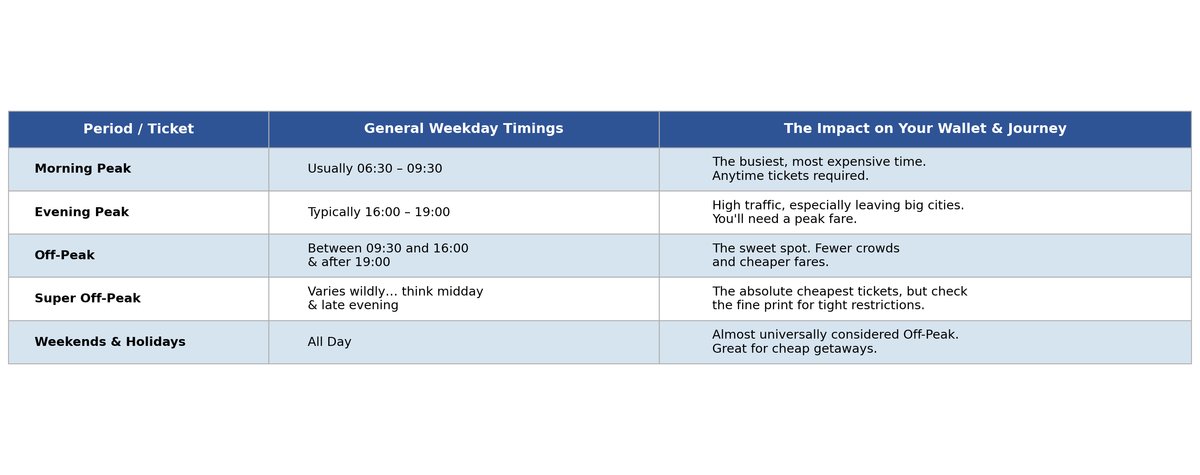
This data is a general guide compiled from National Rail and major TOC guidelines. Always verify with a journey planner for your specific route.
How to Actually Buy the Right Ticket
Getting the best price isn't just about picking a departure time. It's about being strategic. A journey planner is your best friend here because it does the heavy lifting of filtering what's valid.
Here are some pointers for locking in the best price:
Check route-specific restrictions. This is the number one rule. Don't assume the rule from your last journey applies to this one. A journey planner will show you the valid tickets for the train you select.
Look at Advance tickets first. These are single (one-way) tickets released up to 12 weeks ahead. What's interesting is you can often find an "Advance" ticket for a train that runs during Off-Peak hours, and it'll be even cheaper than the standard Off-Peak fare. They're non-flexible, but the savings can be huge.
A Railcard is essential if you travel even a few times a year. It typically gives you 1/3 off Off-Peak (and sometimes Anytime) fares, so it pays for itself very quickly.
Split Ticketing... this is a fantastic tactic for longer journeys. Instead of buying one ticket from A to C, you buy one from A to B and another from B to C. The train doesn't even have to stop at B. As long as it passes through, you're covered. It can lead to massive savings, and sites exist specifically to find these splits for you.
Confirm your ticket covers the whole journey. (This is especially important with split tickets – make sure there are no gaps!)
Questions That Usually Come Up
Read our questions and answers:
How much more restrictive is a Super Off-Peak ticket, really?
The main difference is that Super Off-Peak tickets often restrict travel during an additional period in the middle of the day or have a stricter evening peak exclusion. For example, a standard Off-Peak ticket might let you travel anytime after 09:30, but a Super Off-Peak might require you to wait until 11:00 and avoid travel between 15:30 and 18:30. Always, always check the "ticket restrictions" link before you buy.
My journey starts Off-Peak, but I have to change trains, and the next one is in the peak window. Is my ticket still valid?
This is a classic "gotcha." In most cases, the validity of your ticket is determined by the departure time of the first train in your itinerary. If that train is an Off-Peak service, you're generally fine for the rest of the journey, even if you connect onto a service that's running in the peak window. However, some long-distance operators put specific restrictions on their busiest services (e.g., the 17:00 from King's Cross), so a journey planner is the only way to be 100% sure your ticket combination is valid.
Does Trainline just figure this out for me automatically?
Yes, for the most part. When you search for a journey, the platform only shows you tickets that are valid for the specific train times you select. It handles the complex logic of peak/off-peak restrictions behind the scenes, which is a huge help. It ensures you won't accidentally buy a ticket you can't use for your chosen departure.
Can I really just buy two separate tickets for one journey?
Absolutely. This is split ticketing. Say you're going from London to Edinburgh. You might find it's cheaper to buy a London-York ticket and a York-Edinburgh ticket for the exact same train. As long as the train passes through York, it's perfectly legitimate. You don't get off; you just have two tickets to cover the full route.
Yorkshire Team
The Yorkshire.com editorial team is made up of local writers, content creators, and tourism specialists who are passionate about showcasing the very best of God’s Own Country. With deep roots in Yorkshire’s communities, culture, food scene, landscapes, and visitor economy, the team works closely with local businesses, venues, and organisations to bring readers the latest news, events, travel inspiration, and insider guides from across the region. From hidden gems to headline festivals, Yorkshire.com is dedicated to celebrating everything that makes Yorkshire such a special place to live, work, and visit.
View all articles →